Concepts create idols; only wonder grasps anything. - St Gregory of Nyssa
Showing posts with label Orthodoxy. Show all posts

Monday, October 6, 2014

Mount Athos

"The depth of their devotion defies description."

I had never seen this 60 Minutes segment about Mount Athos. I discovered it in a comment on Fr Stephen Freeman's blog, Glory to God for All Things.

"We didn't understand the words; we really didn't have to."

Watch part 1:


"Kyrie eleison, kyrie eleison, kyrie eleison..."

Watch part 2:

" Holiness seemed to seep from the very stones."


"What I am talking about is the art of salvation."

"The first thing a monk does is embrace and love death."

Saturday, September 27, 2014

Wonder


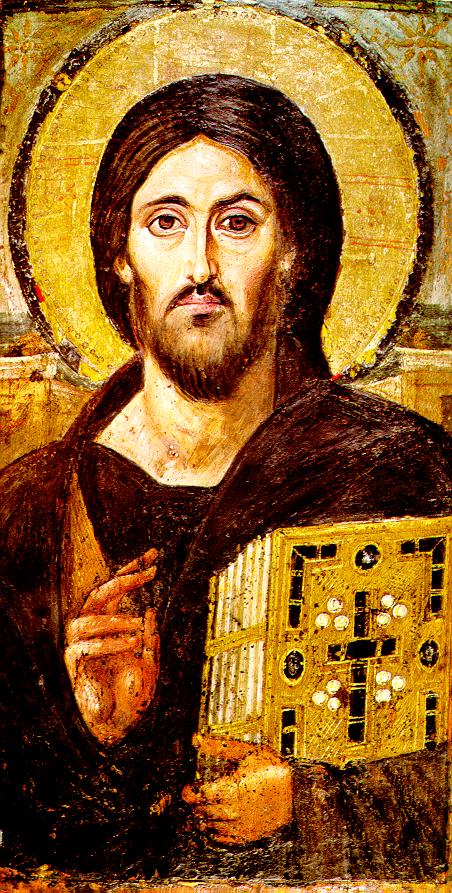
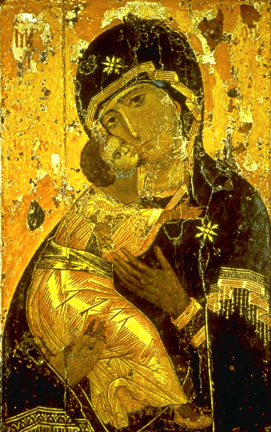
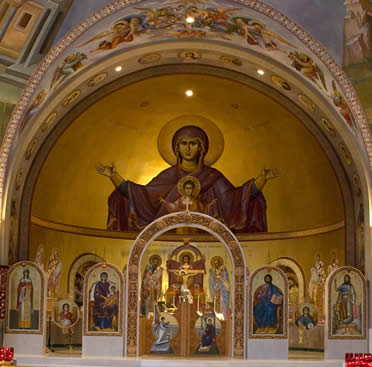
The liturgical art of the Orthodox Church offers the world nothing less than a vision of the Kingdom of God. There can be no higher calling for art than this. Liturgical art is the combined effort of apostles and theologians, hymnographers and composers, architects and painters, all manner of craftsmen, and the clergy and choir at every service, to reveal through so many arts the living reality of the Kingdom of God.


So begins the multi-part series at Orthodox Arts Journal on the Integrated Expression of the all the Liturgical Arts, by Andrew Gould.


He continues, in part:

This broken history and the academic bias of the modern world have led to a certain imbalance. Sacred texts are treated with great importance in our seminaries, and churches make every effort to present them appropriately. But the other arts are often dismissed as mere decoration for the texts. Icons are understood as just another way of showing us what we already know from texts. Music is just a way to make hymnography sound pretty and dignified. And architecture, vestments, and furniture are only there to lend appropriate decorum and symbolism to a service whose real purpose is the worship of God through scripture and prayers.

This view is false. Sacred texts are not alone in expressing divinity. Everything in the world has the capacity to reveal God to us, and every form of liturgical art reveals God in its own way. An icon is holy because it shows us something uniquely visual about God’s Kingdom.... Even the smallest arts ... directly represent an aspect of God’s Kingdom.... Ours is not the religion in which the Logos became text. Christ became flesh, and he revealed the Father to us not only in his words, but in his very appearance.


Thought-provoking words. In America, Orthodox suffer from what I call the "American Religion," which simply put, is Calvinism liberally mixed with patriotism. We are iconoclastic, and text-oriented (yup, imbibing at the Sola Scriptura fountain, whether we realize it or not). In America we are also arts illiterates: can we distinguish finely-wrought icons from paper glued on a piece of wood, or music from masters vs "pop" music?


As St Gregory of Nyssa said: "Concepts create idols; only wonder grasps anything."


Liturgical art encourages wonder in the faithful. 

Sunday, September 21, 2014

"Leavetaking" of the Exaltation of the Precious Cross

One beautiful attribute of the Church's feast days are the 'forefeast,' the 'afterfeast,' and the 'leavetaking.'

Only the non-moveable feasts of the Church have a forefeast. The forefeasts helps to prepare the faithful for the feast itself. Special troparia and kontakia are assigned to the forefeasts, along the theme of the feastday.

Today, September 21, is the Leavetaking of the Exaltation of the Holy Cross. The feast was celebrated on September 14; the afterfeast (during which the theme of the feast day is continued) was seven days long.


 On the eve of the feast, Vespers was celebrated, and afterwards, the cross, beautifully decorated, was brought out of the Altar while the choir and faithful sing "Holy God" from the Funeral Service.


After the Priest places the decorated cross on the center 'tetrapod' (a fancy term for a four-legged table with icons on it), the choir and faithful sing "Before Thy Cross" three times. Each time, the Priest circles the tetrapod, and censes the Cross at four points: facing east first, then facing north, then facing west, then facing south, finishing (and starting again) facing east.


For the Leavetaking (yes, I got back to it!), the process is reversed (mostly), and the Cross is taken back into the Altar. It seems to me not many parishes do this, but I could be wrong.

From OCA.org:

At the end of Liturgy, the priest comes out from the altar with a censer, preceded by a deacon with a candle. Going to the center of the church, he censes three times around the Cross. He takes the tray with the Cross and places it on his head to carry it into the altar. The deacon goes before him, censing the Cross. After placing the Cross on the altar, the priest censes the four sides of the Holy Table. 

The Leavetaking also has the same Tropar and Kondak, the festal Prokiemenon, and the Hymn to the Theotokos.


Troparion — Tone 1

O Lord, save Your people, /
And bless You inheritance. /
Grant victories to the Orthodox Christians /
Over their adversaries. /
And by virtue of Your Cross, /
Preserve Your habitation.

See this post of an Orthodox Church in Mays Landing, NJ, for a list of feast days and the length of the afterfeast and leavetaking.

Of course, for Pascha, the Feast of Feasts, the afterfeast and leavetaking is different: afterfeast is for 39 days, and the 40th day is the feast of Ascension. See more about this at the OCA website.


Tuesday, September 9, 2014

"Beauty will save the world."


from mind your maker, quoting Vladimir Soloviev's The Heart of Reality:

“Dostoevsky not only preached, but, to a certain degree also demonstrated in his own activity this reunification of concerns common to humanity–at least of the highest among these concerns–in one Christian idea. Being a religious person, he was at the same time a free thinker and a powerful artist. These three aspects , these three higher concerns were not differentiated in him and did not exclude one another, but entered indivisibly into all his activity. In his convictions he never separated truth from good and beauty; in his artistic creativity he never placed beauty apart from the good and the true. And he was right, because these three live only in their unity. The good, taken separately from truth and beauty, is only an indistinct feeling, a powerless upwelling; truth taken abstractly is an empty word; and beauty without truth and the good is an idol. ..."


Sunday, April 15, 2012

CHRIST IS RISEN! TRULY, HE IS RISEN!

This icon is called "The Harrowing of Hell," and is for Holy Saturday. 
It is popularly used for The Great and Holy Pascha of Our Lord, God and Savior Jesus Christ.

Monday, March 26, 2012

The Holy Archangel Gabriel

from Prologue from Ochrid:
(Synaxis of the Archangel Gabriel)

Gabriel is the announcer of the Incarnation of the Son of God. He is one of the seven archangels who stand before the Throne of God. He appeared to Zacharias about the birth of the Forerunner. Gabriel said of himself, "I am Gabriel, who stand before God" (St. Luke 1:19). His name Gabriel means "Man - God." The Holy Fathers, in speaking about the Annunciation, interpret that an archangel with such a name was sent to signify who and what He would be like, who must be born of the All-Pure One. Therefore, He will be Man-God, mighty and powerful God. Some of the Fathers understood that this same Gabriel appeared to Joachim and Anna concerning the birth of the Virgin Mary and that Gabriel instructed Moses in the wilderness to write the Book of Genesis. 

The Holy Fathers think that Gabriel has pre-eminence in the first and greatest order of heavenly powers, that is, the Seraphic Order, since the Seraphims stand closest to God. He is, therefore, one of the seven Seraphims, closest to God. The names of the seven are MICHAEL, GABRIEL, RAPHAEL, URIEL, SALATHIEL, JEGUDIEL, BARACHIEL. To this number some even add JEREMIEL. Each one has their own particular service and all are equal in honor. 

 
Why did God not send Michael? Because Michael's service is to suppress the enemies of the Faith of God while Gabriel's is the mission of announcing the salvation of mankind.

Sunday, March 25, 2012

The Annunciation


from Prologue from Ochrid:

THE HOLY MOTHER OF GOD
(The Theotokos)

O WHAT WONDERFUL NEWS: REJOICE, ALL-PURE ONE,
FOR US, YOU GAVE BIRTH TO CHRIST!
O JOYFUL NEWS: REJOICE O VIRGIN,
RADIANT DOVE!
REJOICE O MARY, REJOICE, O ONE FULL OF GRACE,
YOU, THE GOLDEN GATE!
O BURNING BUSH, UNCONSUMED,
THE DAWN OF NEW SPLENDOR!
GABRIEL COMPOSES THE WORDS, AND HE HIMSELF REJOICES,
THE ANNUNCIATION HE PROCLAIMS!
PROCLAIMS THE ANNUNCIATION, ALL OF HEAVEN LISTENS,
YOUR SOUL TREMBLES!
IN THE TEMPLE YOU SERVED, TO GOD YOU CONSECRATED YOURSELF,
YOU BECAME THE TEMPLE!
REJOICE, O PURE ONE, HEAVENLY BRIDE,
YOU ARE THE ROYAL THRONE!
REJOICE, O HUMBLE ONE, TO THE HUMBLE ONE, YOU
WILL GIVE BIRTH,
AND REGENERATE THE WORLD!
REJOICE, O OBEDIENT ONE, GOD HEARD YOU
AND CROWNED YOU WITH GLORY!
REJOICE, O TEARFUL ONE, BY TEARS SOFTENED,
BY THE SPIRIT GLISTENING!
REJOICE, O POOR ONE, BUT THE WEALTHIEST ONE
AND BRIGHTER THAN THE SUN!
FOR US, PLEAD JOY, FROM CHRIST YOUR SON,
O VIRGIN, ALL-PURE ONE!


Saturday, March 24, 2012

What will happen?

"When I caught sight of Him,I fell down at His feet asthough dead" (Revelation 1:17).

It was St. John who fell as though dead when he saw the Lord Jesus in glory. St. John, the Beloved Disciple of Jesus, The Evangelist, The Chaste One, The one who loved the Lord, and a zealot for holiness - could not stand on his feet nor compose himself when he saw his Teacher in His heavenly glory and power! But, "fell, as though dead." 

How will they, therefore, endure the presence of the Lord and His eyes "a fiery flame," they who sin against Him, they who rise up against Him, they who ridicule His Name, they who despise His love and sacrifice, they who mock His cross, they who trample upon His commandments, they who persecute His Church, they who shame His priests, and they who kill His faithful? 

  • What will happen to them before the face of the Lord when St. John fell as dead when he caught sight of Him? 
  • What will happen to the literate who corrupt? 
  • What will happen to teachers who destroy the Faith in young souls? 
  • What will happen to skeptics who through their doubt poison the minds of men? 
  • What will happen to thieves and robbers and what will happen to the immoral and what will happen to the child-killers? 
  • What will happen to the enemies of Christ when the friend of Jesus falls, as though dead, before His indescribable, glistening glory? 

Such is the glory, power, authority, beauty, lordship, light and majesty of the Lord Jesus, resurrected and ascended, that His closest companions who for three years on earth gazed upon His face without fear, now fall as though dead when they see His face in the heavens following His passion, death and victory!

O Lord All-glorious and Almighty illuminate us and enliven us by Your power and glory.

From the Prologue.

Thursday, March 22, 2012

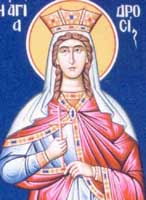
St Drosida

      The Holy Martyress Drosida, together with Five Virgin-Martyrs Agalida, Apollinaria, Daria, Mamthusa and Taisia: Saint Drosida was daughter of the emperor Trajan (98-117), a fierce persecutor of Christians. In the year 99 he re-activated an earlier existing law which forbade secret gatherings and was indirectly aimed against Christians, and in the year 104 he issued a special law against Christians.
      Beginning with this year, the persecutions continued until the end of his reign. During this time the bodies of killed Christians often remained unburied for the purpose of scaring others. Five Christian virgins: Aglaida, Apolliniaria, Daria, Mamthusa and Taisia, took upon themselves the task of burying such Christians. They secretly gathered up the bodies of martyrs, anointed them with aromatics, wrapped them in shroud-cloths and buried them. Having learned of this, the imperial Drosida, secretly a Christian but not yet having accepted Baptism, asked the holy virgins to take her with them, when they would go to make burial of Christians.
      On the advice of the fiancee of Saint Drosida, the court dignitary Adrian, a guard was set nearby those killed, to arrest those who would bury them. And on the very first night Saint Drosida and the five virgins were caught. Having learned that among the captives was his own daughter, Trajan gave orders to hold her separately, in the hope that she would change her mind. The remaining holy virgins were sentenced to burning in a copper-foundry furnace. They bravely accepted execution and were vouchsafed martyrs crowns. From the copper, mingled with the ashes of the martyresses, were molded tripods for a new bath of Trajan. But as long as these tripods stood in the bath-house, no man was able to enter there: anyone crossing the threshold fell down dead. When the pagan priests perceived from whence this happened, they gave advice to remove the tripods.
      Then Adrian suggested to the emperor to remelt the tripods and to make from them five statues of naked virgins, resembling the executed martyresses, and for mockery and jeering to place these statues in front of the entrance to the imperial bath. Trajan agreed. When the statues were set up, the emperor saw in a dream five pure lambs pastured in paradise, and the shepherd which did say to him: "O most wanton and wicked Caesar! Those, the depictions of whom thou intended to set up for mockery, the Good and Merciful Pastor hath snatched away from thee and settled here, whither in time shalt also be the pure lamb Drosida, thine daughter". Having awakened, the wanton Trajan went into a rage and gave orders to fire up two huge furnaces and to fire them up daily. At the ovens was put up an imperial edict: "Men of the Galileian, ye worshiping the Crucified, deliver yourselves from a great many agonies, and us also from these labours: offer sacrifice to the gods. If ye however wish not to do this, then let each of you voluntarily, by whatever manner he wanteth, cast himself into this furnace". Many Christians voluntarily went to martyrdom.
      Having learned of this, Saint Drosida decided likewise to accept a martyr's death for Christ. In her imprisonment she offered up prayers that the Lord would help her exit from the prison. And God heard her prayer: the guards fell asleep. Set free, Saint Drosida went off towards the ovens, but began to ponder within herself: "How can I go to God, not having upon myself the wedding garb (i.e. not having been baptised), since I am impure. But, O King of kings Lord Jesus Christ, on account of Thee I do forsake my imperial position, so that Thou might vouchsafe me to be the very least doormaid in Thine kingdom. Do Thou Thyself baptise me with Thine Holy Spirit". Having thus prayed, Saint Drosida anointed herself with myrh (chrism), which she had taken along with her, and thrice submerging herself in water, pronounced: "the servant of God Drosida is baptised in the Name of the Father, and of the Son, and of the Holy Spirit". For seven days the saint hid herself, devoted to fasting and prayer. During this time Christians found her and learned from her the account of everything that occurred. And on the eighth day the holy Martyress Drosida went to the red-hot ovens and cast herself into the fire.

from http://www.holytrinityorthodox.com/calendar

Tuesday, March 20, 2012

St Photini

Commemorated on March 20

The Holy Martyr Photina (Svetlana) the Samaritan Woman, her sons Victor (named Photinus) and Joses; and her sisters Anatola, Phota, Photis, Paraskeva, Kyriake; Nero's daughter Domnina; and the Martyr Sebastian: The holy Martyr Photina was the Samaritan Woman, with whom the Savior conversed at Jacob's Well (John. 4:5-42).

During the time of the emperor Nero (54-68), who displayed excessive cruelty against Christians, St Photina lived in Carthage with her younger son Joses and fearlessly preached the Gospel there. Her eldest son Victor fought bravely in the Roman army against barbarians, and was appointed military commander in the city of Attalia (Asia Minor). Later, Nero called him to Italy to arrest and punish Christians.

Sebastian, an official in Italy, said to St Victor, "I know that you, your mother and your brother, are followers of Christ. As a friend I advise you to submit to the will of the emperor. If you inform on any Christians, you will receive their wealth. I shall write to your mother and brother, asking them not to preach Christ in public. Let them practice their faith in secret."

St Victor replied, "I want to be a preacher of Christianity like my mother and brother." Sebastian said, "O Victor, we all know what woes await you, your mother and brother." Then Sebastian suddenly felt a sharp pain in his eyes. He was dumbfounded, and his face was somber.

For three days he lay there blind, without uttering a word. On the fourth day he declared, "The God of the Christians is the only true God." St Victor asked why Sebastian had suddenly changed his mind. Sebastian replied, "Because Christ is calling me." Soon he was baptized, and immediately regained his sight. St Sebastian's servants, after witnessing the miracle, were also baptized.

Reports of this reached Nero, and he commanded that the Christians be brought to him at Rome. Then the Lord Himself appeared to the confessors and said, "Fear not, for I am with you. Nero, and all who serve him, will be vanquished." The Lord said to St Victor, "From this day forward, your name will be Photinus, because through you, many will be enlightened and will believe in Me." The Lord then told the Christians to strengthen and encourage St Sebastian to peresevere until the end.

All these things, and even future events, were revealed to St Photina. She left Carthage in the company of several Christians and joined the confessors in Rome.

At Rome the emperor ordered the saints to be brought before him and he asked them whether they truly believed in Christ. All the confessors refused to renounce the Savior. Then the emperor gave orders to smash the martyrs' finger joints. During the torments, the confessors felt no pain, and their hands remained unharmed.

Nero ordered that Sts Sebastian, Photinus and Joses be blinded and locked up in prison, and St Photina and her five sisters Anatola, Phota, Photis, Paraskeva and Kyriake were sent to the imperial court under the supervision of Nero's daughter Domnina. St Photina converted both Domnina and all her servants to Christ. She also converted a sorcerer, who had brought her poisoned food to kill her.

Three years passed, and Nero sent to the prison for one of his servants, who had been locked up. The messengers reported to him that Sts Sebastian, Photinus and Joses, who had been blinded, had completely recovered, and that people were visiting them to hear their preaching, and indeed the whole prison had been transformed into a bright and fragrant place where God was glorified.

Nero then gave orders to crucify the saints, and to beat their naked bodies with straps. On the fourth day the emperor sent servants to see whether the martyrs were still alive. But, approaching the place of the tortures, the servants fell blind. An angel of the Lord freed the martyrs from their crosses and healed them. The saints took pity on the blinded servants, and restored their sight by their prayers to the Lord. Those who were healed came to believe in Christ and were soon baptized.

In an impotent rage Nero gave orders to flay the skin from St Photina and to throw the martyr down a well. Sebastian, Photinus and Joses had their legs cut off, and they were thrown to dogs, and then had their skin flayed off. The sisters of St Photina also suffered terrible torments. Nero gave orders to cut off their breasts and then to flay their skin. An expert in cruelty, the emperor readied the fiercest execution for St Photis: they tied her by the feet to the tops of two bent-over trees. When the ropes were cut the trees sprang upright and tore the martyr apart. The emperor ordered the others beheaded. St Photina was removed from the well and locked up in prison for twenty days.

After this Nero had her brought to him and asked if she would now relent and offer sacrifice to the idols. St Photina spit in the face of the emperor, and laughing at him, said, "O most impious of the blind, you profligate and stupid man! Do you think me so deluded that I would consent to renounce my Lord Christ and instead offer sacrifice to idols as blind as you?"

Hearing such words, Nero gave orders to again throw the martyr down the well, where she surrendered her soul to God (+ ca. 66).

Saturday, March 17, 2012

St Patrick

It's not all about green beer and Irish songs.
 
Commemorated on March 17

Saint Patrick, the Enlightener of Ireland was born around 385, the son of Calpurnius, a Roman decurion (an official responsible for collecting taxes). He lived in the village of Bannavem Taberniae, which may have been located at the mouth of the Severn River in Wales. The district was raided by pirates when Patrick was sixteen, and he was one of those taken captive. He was brought to Ireland and sold as a slave, and was put to work as a herder of swine on a mountain identified with Slemish in Co. Antrim. During his period of slavery, Patrick acquired a proficiency in the Irish language which was very useful to him in his later mission.

He prayed during his solitude on the mountain, and lived this way for six years. He had two visions. The first told him he would return to his home. The second told him his ship was ready. Setting off on foot, Patrick walked two hundred miles to the coast. There he succeeded in boarding a ship, and returned to his parents in Britain.

Some time later, he went to Gaul and studied for the priesthood at Auxerre under St Germanus (July 31). Eventually, he was consecrated as a bishop, and was entrusted with the mission to Ireland, succeeding St Palladius (July 7). St Palladius did not achieve much success in Ireland. After about a year he went to Scotland, where he died in 432.

Patrick had a dream in which an angel came to him bearing many letters. Selecting one inscribed "The Voice of the Irish," he heard the Irish entreating him to come back to them.

Although St Patrick achieved remarkable results in spreading the Gospel, he was not the first or only missionary in Ireland. He arrived around 432 (though this date is disputed), about a year after St Palladius began his mission to Ireland. There were also other missionaries who were active on the southeast coast, but it was St Patrick who had the greatest influence and success in preaching the Gospel of Christ. Therefore, he is known as "The Enlightener of Ireland."

His autobiographical Confession tells of the many trials and disappointments he endured. Patrick had once confided to a friend that he was troubled by a certain sin he had committed before he was fifteen years old. The friend assured him of God's mercy, and even supported Patrick's nomination as bishop. Later, he turned against him and revealed what Patrick had told him in an attempt to prevent his consecration. Many years later, Patrick still grieved for his dear friend who had publicly shamed him.

St Patrick founded many churches and monasteries across Ireland, but the conversion of the Irish people was no easy task. There was much hostility, and he was assaulted several times. He faced danger, and insults, and he was reproached for being a foreigner and a former slave. There was also a very real possibility that the pagans would try to kill him. Despite many obstacles, he remained faithful to his calling, and he baptized many people into Christ.

The saint's Epistle to Coroticus is also an authentic work. In it he denounces the attack of Coroticus' men on one of his congregations. The Breastplate (Lorica) is also attributed to St Patrick. In his writings, we can see St Patrick's awareness that he had been called by God, as well as his determination and modesty in undertaking his missionary work. He refers to himself as "a sinner," "the most ignorant and of least account," and as someone who was "despised by many." He ascribes his success to God, rather than to his own talents: "I owe it to God's grace that through me so many people should be born again to Him."

By the time he established his episcopal See in Armargh in 444, St Patrick had other bishops to assist him, many native priests and deacons, and he encouraged the growth of monasticism.

St Patrick is often depicted holding a shamrock, or with snakes fleeing from him. He used the shamrock to illustrate the doctrine of the Holy Trinity. Its three leaves growing out of a single stem helped him to explain the concept of one God in three Persons. Many people now regard the story of St Patrick driving all the snakes out of Ireland as having no historical basis.

St Patrick died on March 17, 461 (some say 492). There are various accounts of his last days, but they are mostly legendary. Muirchu says that no one knows the place where St Patrick is buried. St Columba of Iona (June 9) says that the Holy Spirit revealed to him that Patrick was buried at Saul, the site of his first church. A granite slab was placed at his traditional grave site in Downpatrick in 1899.

Thursday, March 15, 2012

Wednesday, March 14, 2012

Lenten Prayer

O Lord and Master of my life, take from me the spirit of sloth, despair, lust for power and idle talk.  
(Prostration)

But give rather a spirit of chastity, humility, patience and love to Thy servant.  
(Prostration)

Yea, O Lord and King, grant me to see my own transgressions and not to judge my brother, for blessed are Thou unto ages of ages. Amen.  
(Prostration)

St Ephraim the Syrian's Prayer.

Tuesday, March 13, 2012

Have mercy...

Irmos We have sinned, transgressed, done wrong before Thee, we have not watched or done as Thou hast commanded us. But do not give us up utterly, O God of our Fathers. 

Refrain: Have mercy on me, O God, have mercy on me.


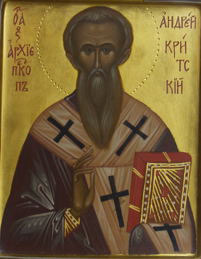
Song 7 of the Great Canon of St Andrew of Crete.

Tuesday, March 6, 2012

Communion


CONTEMPLATION
To contemplate the Mystery of Communion as a life-giving cure for the soul and body:
1. As a cure that heals and cleanses the soul from sinful maladies and restores it to life;
2. As a cure that heals and cleanses the body from avarice and vice and restores it to life;
3. As a cure that enlivens man and makes him a healthy member of the immortal Body of Christ, who, if he is not, would remain decayed to the end and eventually, he would be cut off and cast aside.

From the Prologue.

Monday, March 5, 2012

Fasting

Father Thomas Hopko:

A special word must be said about fasting during lent. Generally speaking, fasting is an essential element of the Christian Life. Christ fasted and taught men to fast. Blessed fasting is done in secret, without ostentation or accusation of others (Mt 6:16; Rom 14). It has as its goal the purification of our lives, the liberation of our souls and bodies from sin, the strengthening of our human powers of love for God and man, the enlightening of our entire being for communion with the Blessed Trinity. 

The Orthodox rules for lenten fasting are the monastic rules. No meat is allowed after Meatfare Sunday, and no eggs or dairy products after Cheesefare Sunday. These rules exist not as a Pharisaic “burden too hard to bear” (Lk 11:46), but as an ideal to be striven for; not as an end in themselves, but as a means to spiritual perfection crowned in love. The lenten services themselves continually remind us of this.
Let us fast with a fast pleasing to the Lord. This is the true fast: the casting off of evil, the bridling of the tongue, the cutting off of anger, the cessation of lusts, evil talking, lies and cursing. The stopping of these is the fast true and acceptable. (Monday Vespers of the First Week)
The lenten services also make the undeniable point that we should not pride ourselves with external fasting since the devil also never eats! 

More here.

Saturday, March 3, 2012

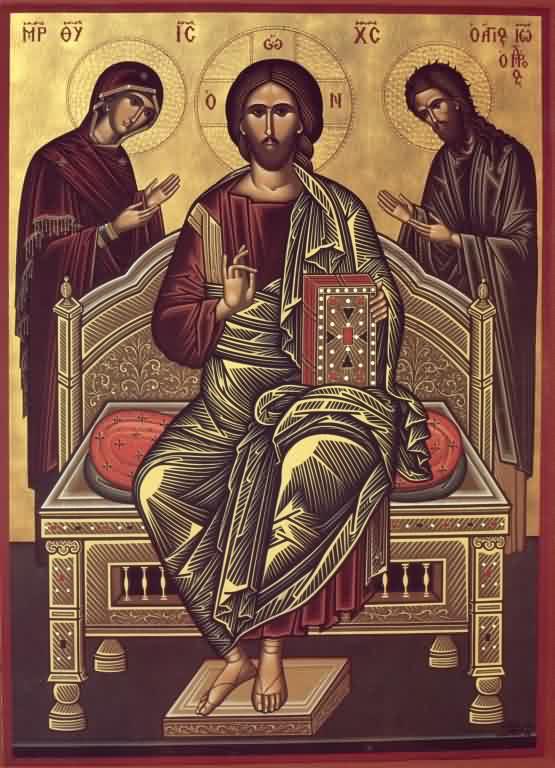
Deisis

He said to them, “ My cup you shall drink; but to sit on My right and on My left, this is not Mine to give, but it is for those for whom it has been prepared by My Father.”  
Matthew 20:23


Image from OrthodoxPhotos.com

Friday, March 2, 2012

Thursday, March 1, 2012

Essence


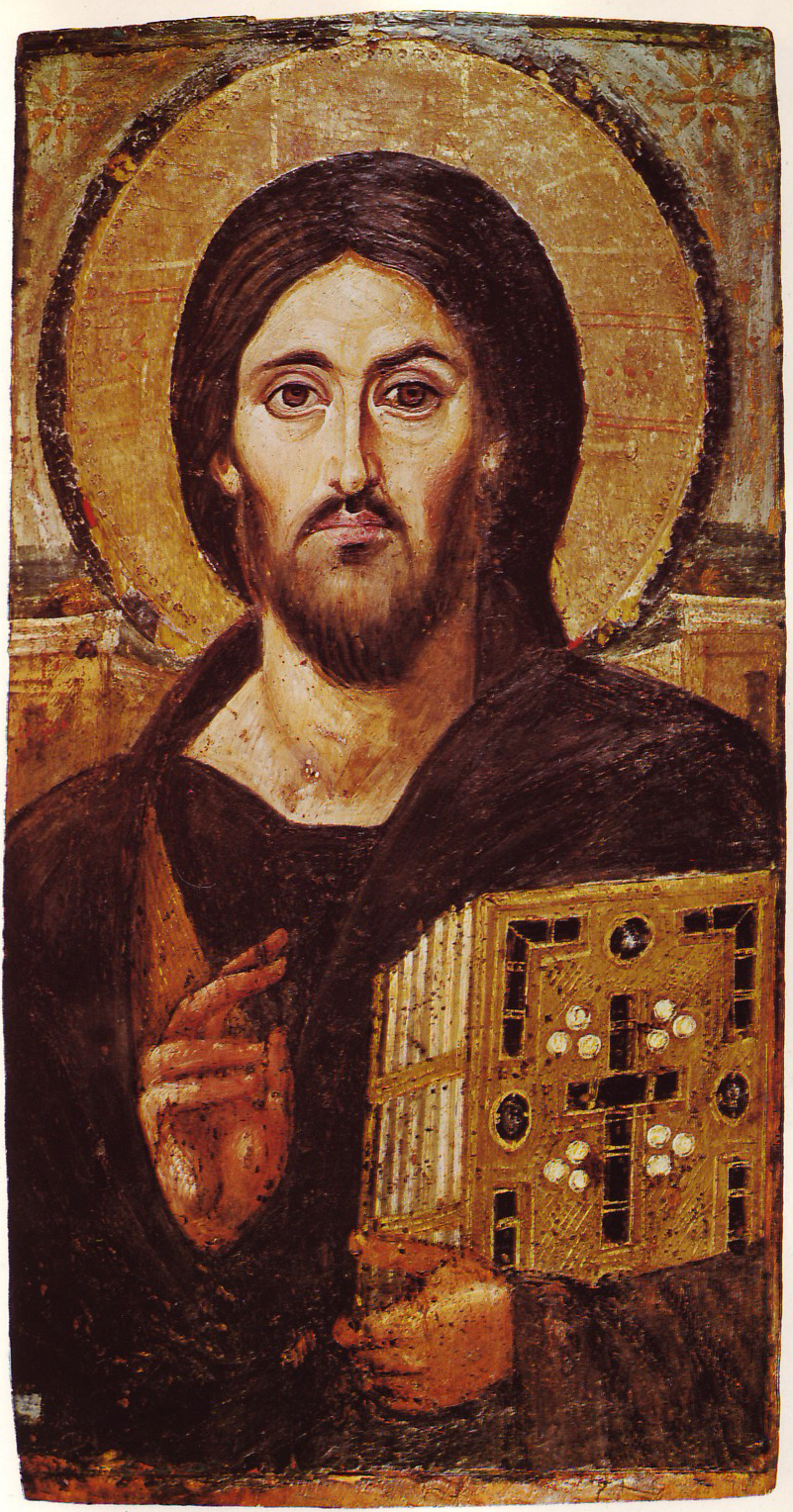
...I believe in Jesus Christ...begotten, not made, of one essence with the Father...


Homoousios is a Greek word meaning "same substance" or "same essence." It is used in the Nicene Creed to say that Jesus Christ is of one essence with the Father. Although it does not appear in the Bible, the fathers of the First Ecumenical Council ultimately decided that this was the best language to use concerning the Holy Trinity.


John 14:9
Jesus said to him, “Have I been so long with you, and yet you have not come to know Me, Philip? He who has seen Me has seen the Father; how can you say, ‘Show us the Father’?