Concepts create idols; only wonder grasps anything. - St Gregory of Nyssa
Showing posts with label icon. Show all posts

Saturday, March 3, 2012

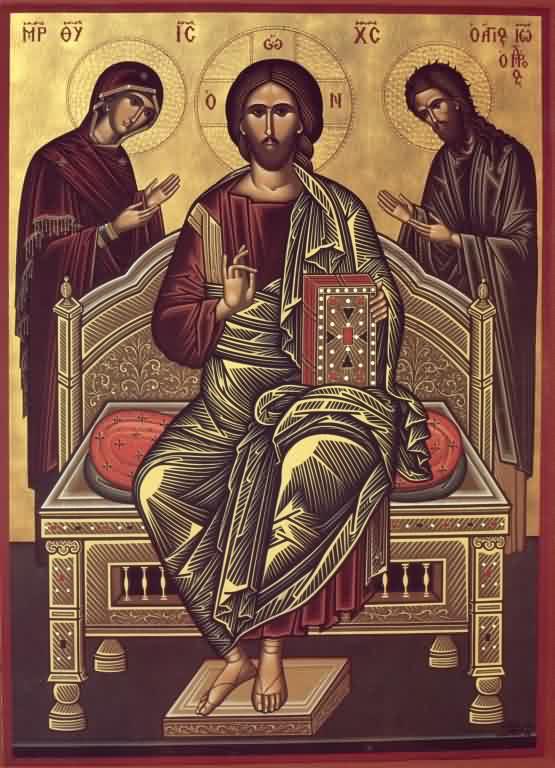
Deisis

He said to them, “ My cup you shall drink; but to sit on My right and on My left, this is not Mine to give, but it is for those for whom it has been prepared by My Father.”  
Matthew 20:23


Image from OrthodoxPhotos.com

Monday, January 2, 2012

St Juliana

Commemorated January 2

In Russia, the merciful Juliana provided just such a example of piety and spiritual purity as the women had revealed to the venerable Macarius in the East, in Christian antiquity. Her life teaches us that even in the world, even within a family, amid cares for children, spouse and members of one's household, one may please God no less than one who withdraws from the world to a monastic cell: one only need live according to the demands of the love of Christ and the righteousness of the Gospel.

The merciful Juliana was born in Moscow, in the palace milieu, to pious and philanthropic parents named Justin and Stephanida Nedyurev. Her father served as the steward at the court of Tsar Ivan IV Vasilievich, known as the Terrible. Justin and Stephanida lived in all reverence and purity, with their sons and daughters, and a multitude of servants, possessed of great riches. Into their family the blessed Juliana was born in the 1530s...

Read the rest here, and here.

Righteous Juliana, my heavenly patroness, pray for each person reading this today, that the Lord would have mercy on their souls.


O merciful Juliana, helper of orphans, mother who bore thy cross! With thy generous right hand make bestowal upon us who now pray to thee, and ask the all-merciful God, Whose very name is love, that He grant us rich mercies. Be thou a good helper unto mothers who have given birth unto children; a holy preserver of purity and love within marriage; a wise nurturer of little children and youths; a compassionate comforter of the orphaned and sorrowful; a sympathetic healer of those who are tempest-tossed by sins; a mighty defender of those subjected to trials by their enemies; and a merciful mediator before God and the all-pure Theotokos for all who ask thine aid. And pray thou all the more, O holy favorite of God, that we be given the grace of the all-holy Spirit, that preserved thereby and saved unceasingly in this life, with thee we may glorify the all-merciful Redeemer, our Lord and Savior Jesus Christ, to Whom is due glory, with His all-good Father and His holy and all-compassionate Spirit, unto the ages of ages. Amen.

Wednesday, October 12, 2011

Torn

From the site Orthodox Christian Faith:


By Saint John Maximovitch 

 The world was created good and called to the joy of life in union with the Source and Creator of life, the Lord God.
 
The first to sin and to be torn from this union were angels. The angelic realm was split: some remained with God; others, in their pride, desired to live their own life, independent of God. The angelic world was split and sin was born there, but the earthly world remained good. 

Read the rest here.


St John, pray for us sinners.

Saturday, October 1, 2011

The Protection of the Most Holy Theotokos; St Romanus

Commemorated October 1

From time immemorial, the Church has celebrated the Most-holy Theotokos as the patroness and protectress of the Christian people, who, by her intercessory prayers, implores God's mercy for us sinners. The help of the Most-holy Mother of God has been clearly shown numerous times, to individuals and to nations, in peace and in war, in monastic deserts and in densely populated cities. The event that the Church commemorates and celebrates today confirms the Theotokos' consistent protection of Christian people. 

On October 1, 911, during the reign of Emperor Leo the Wise, there was an All-night Vigil in the Blachernae Church of the Mother of God in Constantinople. The church was full of people. St. Andrew the Fool-for-Christ was standing in the rear of the church with his disciple Epiphanius. At four o'clock in the morning, the Most-holy Theotokos appeared above the people, holding her omophorion outstretched as a protective covering for the faithful. She was clothed in gold-encrusted purple, and shone with an ineffable radiance, surrounded by apostles, saints, martyrs and virgins. St. Andrew said to Blessed Epiphanius: ``Do you see, brother, the Queen and Lady of all praying for the whole world?'' Epiphanius replied: ``I see, Father, and am struck with amazement!'' 

The Feast of the Protection was instituted to commemorate this event, and to remind us that we can prayerfully receive the unceasing protection of the Most-holy Theotokos in any time of difficulty.


The Venerable Romanus the Melodist

Romanus was born in the Syrian town of Emesa. He was, at first, a sexton in Beirut, and later served in the cathedral church in Constantinople in the time of Patriarch Euthymius (490-504). Romanus was not well educated and was untrained in chanting, for which he was ridiculed by some of the more educated clergy. St. Romanus tearfully prayed to the Most-holy Theotokos, and she appeared to him in a dream, gave him a scroll, and told him to swallow it. The following day was the Feast of the Nativity. Romanus took his place as a chanter at the ambo, and with an angelic voice sang the hymn ``Today the Virgin….'' All were amazed at both the content of this hymn and at the magnificent singing of the chanter. Having received the poetic gift from the Theotokos, Romanus composed over a thousand Kontakia. Romanus entered into rest as a deacon of the Great Church, Hagia Sophia, in Constantinople. He joined the angelic choirs in the year 510.

Friday, September 30, 2011

Overload

Anyone with a brain and access to any kind of news knows that the situation in the US is dire, and rapidly declining. There is enough bad news on the intertubes. NO need for more here.

So come here for a little refreshment, like this:


I [says Father Stephen] have made a contrast between what I have termed a literal view of reality and an iconic view of reality. In the literal view, things are things. What you see is what there is. In an iconic view, things point to something beyond themselves – they make present that to which they point.
610x

Blessed are the pure in heart for they shall see God.
From time to time, I have written about the iconic character of reality – the world about us has the character of an icon. I have also noted the iconic character of language and of Scripture. There is much to say about what is meant by such descriptions as well as what it means to see things in an “iconic” manner.
However, there is much more to this than the mere act of seeing. To see an icon requires that we also be in relationship with that which it represents. Christ is present in His icon but is only made manifest to us because we are in relationship with Him. Thus I have said that to see an icon properly involves its veneration. Veneration is an expression of our relationship with that which is represented.
An important aspect of icons (in the teaching of the Church) is that an icon must be true. We cannot make icons of that which is not true.

As always, Fr Stephen's writings are worth reading. Read the rest of this excellent post here.

Sunday, September 4, 2011

A damaged icon

 Metropolitan + Anthony (Bloom) of Sourozh

Every one of us is in the image of God, and every one of us is like a damaged icon. But if we were given an icon damaged by time, damaged by circumstances, or desecrated by human hatred, we would treat it with reverence, with tenderness, with broken-heartedness.


Read the rest at Milk and Honey.

Tuesday, August 16, 2011

Not Made With Hands


The Icon of the Lord Jesus Christ, "Not Made With Hands".


At the time when our Lord preached the Good News and healed every illness and infirmity of men, there lived in the city of Edessa on the shore of the Euphrates Prince Abgar who was completely infected with leprosy. He heard of Christ, the Healer of every pain and disease and sent an artist, Ananias, to Palestine with a letter to Christ in which he begged the Lord to come to Edessa and to cure him of leprosy. In the event that the Lord was unable to come, the prince ordered Ananias to portray His likeness and to bring it to him, believing that this likeness would be able to restore his health.

The Lord answered that He was unable to come, for the time of His passion was approaching took a towel, wiped His face and, on the towel, His All-pure face was perfectly pictured. The Lord gave this towel to Ananias with the message that the prince will be healed by it, but not entirely, and later on, He would send him a messenger who would erase the remainder of his disease.

Receiving the towel, Prince Abgar kissed it and the leprosy completely fell from his body but a little of it remained on his face. Later, the Apostle Thaddaeus, preaching the Gospel, came to Abgar and secretly healed and baptized him. The prince then destroyed the idols which stood before the gates of the city and above the gates he placed the towel with the likeness of Christ attached to wood, framed in a gold frame and adorned with pearls. Also, the prince wrote beneath the icon on the gates: "O Christ God, no one will be ashamed who hopes in You." Later, one of Abgar's great grandsons restored idolatry and the bishop of Edessa came by night and walled up that icon over the gates. Centuries have passed since then.

During the reign of Emperor Justinian, the Persian King Chozroes attacked Edessa and the city was in great hardship. It happened that Eulabius, the Bishop of Edessa, had a vision of the All-Holy Theotokos who revealed to him the mystery of the sealed wall and the forgotten icon. The icon was discovered and, by its power, the Persian army was defeated.

From the Prologue from Ochrid.

Saturday, August 6, 2011

The Holy Transfiguration of Our Lord God and Savior Jesus Christ


Discourse on the Holy Transfiguration of Our Lord God and Savior Jesus Christ of Saint Gregory Palamas, Archbishop of Thessalonica :
...
"What does it mean to say: He was transfigured?" asks the Golden-Mouthed Theologian (Chrysostom). He answers this by saying: "It revealed something of His Divinity to them, as much and insofar as they were able to apprehend it, and it showed the indwelling of God within Him." The Evangelist Luke says: "And as He prayed, His countenance was altered" (Luke 9:29); and from the Evangelist Matthew we read: "And His face shone as the sun" (Mt.17:2). But the Evangelist said this, not in the context that this Light be thought of as subsistent for the senses (let us put aside the blindness of mind of those who can conceive of nothing higher than what is known through the senses). Rather, it is to show that Christ God, for those living and contemplating by the Spirit, is the same as the sun is for those living in the flesh and contemplating by the senses. Therefore, some other Light for the knowing the Divinity is not necessary for those who are enriched by Divine gifts.

That same Inscrutable Light shone and was mysteriously manifest to the Apostles and the foremost of the Prophets at that moment, when (the Lord) was praying. This shows that what brought forth this blessed sight was prayer, and that the radiance occured and was manifest by uniting the mind with God, and that it is granted to all who, with constant exercise in efforts of virtue and prayer, strive with their mind towards God. True beauty, essentially, can be contemplated only with a purified mind. To gaze upon its luminance assumes a sort of participation in it, as though some bright ray etches itself upon the face.

Even the face of Moses was illumined by his association with God. Do you not know that Moses was transfigured when he went up the mountain, and there beheld the Glory of God? But he (Moses) did not effect this, but rather he underwent a transfiguration. However, our Lord Jesus Christ possessed that Light Himself. In this regard, actually, He did not need prayer for His flesh to radiate with the Divine Light; it was but to show from whence that Light descends upon the saints of God, and how to contemplate it....

From OCA.org.

Monday, July 4, 2011

St Andrew Rublev, commemorated July 4

Saint Andrew Rublev, Russia's greatest iconographer, was born near Moscow sometime between 1360 and 1370. While still very young, he went to the Holy Trinity Monastery, and was profoundly impressed by St Sergius of Radonezh (September 25).

After the death of St Sergius in 1392, St Nikon (November 17) succeeded him as igumen. St Andrew became a novice in the monastery under St Nikon. Sometime before 1405 he moved to the Spaso-Andronikov Monastery founded by St Andronicus (June 13), with the blessing of St Nikon.There St Andrew received monastic tonsure and was taught iconography by Theophanes the Greek and the monk Daniel, St Andrew's friend and fellow-ascetic.

St Andrew is first mentioned in the Chronicles in 1405, when he, Theophanes, and Prochorus painted the cathedral of the Annunciation. His next important project, which he undertook with the monk Daniel, was to paint the frescoes in the Dormition Cathedral in Vladimir in 1408.

St Nikon of Radonezh asked St Andrew and Daniel to paint the new church in the reconstructed monastery of the Holy Trinity, which had been destroyed by the Tatars in 1408. At this time St Andrew painted his most famous icon: the Holy Trinity (actually, the Hospitality of Abraham).

St Andrew fell asleep in the Lord between 1427-1430, and was buried in the Andronikov Monastery. He was over seventy years old at the time of his death. The monk Daniel, who died before St Andrew, appeared to his friend and urged him to join him in eternal blessedness.

Saturday, July 2, 2011

Blachernae

Commemorated on July 2:

The Placing of the Venerable Robe of the Most Holy Theotokos at Blachernae: During the reign of the Byzantine Emperor Leo the Great (457-474), the brothers Galbius and Candidus, associates of the emperor, set out from Constantinople to Palestine to venerate the holy places. In a small settlement near Nazareth they stayed in the home of a certain old Jewish woman. In her house they noticed a room where many lamps were lit, incense burned, and sick people were gathered. When they asked her what the room contained, the pious woman did not want to give an answer for a long time. After persistent requests, she said that she had a very precious sacred item: the Robe of the Mother of God, which performed many miracles and healings. Before Her Dormition the Most Holy Virgin bequeathed one of her garments to a pious Jewish maiden, an ancestor of the old woman, instructing her to leave it to another virgin after her death. Thus, the Robe of the Mother of God was preserved in this family from generation to generation. 

Read the rest here.

Thursday, June 23, 2011

Theotokos of Vladimir

From the Prologue from Ochrid:

The Commemoration of the Icon of the All-Holy Birth-Giver of God, 
of the town of Vladimir

When the Tartar King Ahmet besieged Moscow, Prince John Vasillievitch set out with an army to defend the city. Even though the army of Prince John was smaller in number and weaker than the Tartar army, nevertheless, it emerged victorious. All at once, an indescribable fear overcame the Tartars and they became confused and fled. Everyone ascribed this unexpected success to the icon of the All-Holy Birth-giver of God before whom the Russian people prayed for salvation from the Tartars. As a result of this, June 23 was designated in Russia for the commemoration of this miracle.

Most Holy Theotokos, pray for us!

Wednesday, June 8, 2011

Gilding

I learned a different method to gild an icon; instead of painting a thin wash of vodka and water on the bole (as this video shows), I used my breath to activate the bole to accept the gold leaf and adhere. The bole was a combination of red clay, rabbit skin glue, and water.

This is fascinating:

Wednesday, January 14, 2009

Searching for Christ, the Pantocrator


Jesus Christ, Son of God, have mercy on me the sinner...

About eleven years ago, I went on a trip to visit some out-of-state friends. One evening we were sitting in their living room, and I was looking at a catalog from Conciliar Press. As I paged through the section of icons, I recall seeing the icon above (from St Catherine's monastery at Mt Sinai), and saying, "Look, there's the face of my Lord!" ...or something very close to that.

Holy God, Holy Mighty, Holy Immortal, have mercy on us...

The first Orthodox services I ever attended were during this trip with my friends: Vespers on Saturday evening, and then Divine Liturgy on the Lord's day. As I recall, we skipped Orthros, since my friends thought the matins service plus Liturgy would be too much for this neophyte! It was all so strange and awe-full, and it was everything my heart had been yearning for. As I progressed in my catechumenate, I also began to discern a depth of thought which I knew I would never exhaust, and a physical discipline desperately needed by my body and soul.

I had found the full expression of the Gospel, what I had been looking for since my youngest days: the One who had made the trees and everything else in the world, including me. I will tell you that story another time.

Jesus Christ, Son of the living God, have mercy on me the sinner...